




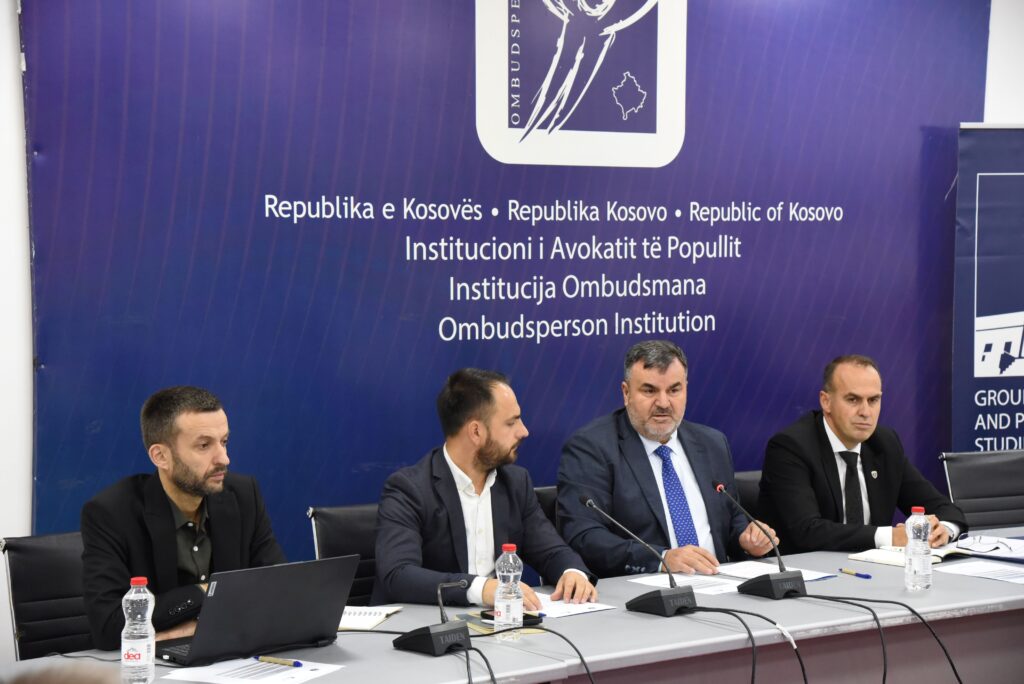
Roundtable Discussion Held on New Court Fee Rates


Pristina, October 9, 2026 – The Ombudsperson, in cooperation with the non-governmental organization “Group for Legal and Political Studies” (GLPS), organized a roundtable discussion regarding the impact of the Administrative Instruction on the Unification of Court Fees on the realization of the right to access justice.
Ombudsperson Mr. Naim Qelaj highlighted that he had issued an Opinion raising concerns regarding the significant increase in certain court fees, additional charges, and the exercise of legal remedies. He added that the setting of court fees must be balanced so as not to create obstacles for citizens in accessing justice.
“These elements, taken together, could create disproportionate financial barriers for citizens seeking judicial protection,” said Qelaj.
He noted that the Opinion addresses not only the impact of court fees but also the responsibility of institutions to ensure that citizens have a genuine opportunity to seek protection for their rights. Liridon Salihi, a project manager at GLPS, expressed the organization’s concern regarding the legal basis for court fees and highlighted that some of them have increased by up to 600 percent.
“Our primary concern relates to the legal basis. As the Ombudsperson also noted, while the Law on the Kosovo Judicial Council grants the KJC the authority to unify court fees, the question arises: should this be interpreted as the right to determine both the imposition and the amount of fees for specific services provided by the judiciary?” said Salihi.
Speaking on behalf of the Kosovo Judicial Council, Judge Agron Maxhuni stated that following internal procedures, the Judicial Council took action to unify court fees across the Republic of Kosovo. He added that this administrative instruction underwent an extensive internal and external consultation process involving all Kosovo courts and organizations that monitor the country’s judicial system. He further noted that the KJC would conduct a comprehensive analysis of the instruction’s impact after the initial one-year period had elapsed. Other participants at the roundtable emphasized that changes to court fee levels must be grounded in sound financial analysis and assessments of their impact on citizens’ rights. It was highlighted that fee increases—in some instances reaching up to 600%—require data-driven justification that takes into account the citizens’ economic situation.
Furthermore, the discussion underscored the need to uphold the principle of proportionality and guarantee equal access to justice. It was stressed that court fees must be proportionate to citizens’ economic circumstances and must not create a barrier to the exercise of their rights. Court fees should not be viewed merely as procedural costs but must also be evaluated in relation to the right to effective access to justice.