


Ombudsperson institution held a roundtable about the rights of minority communities


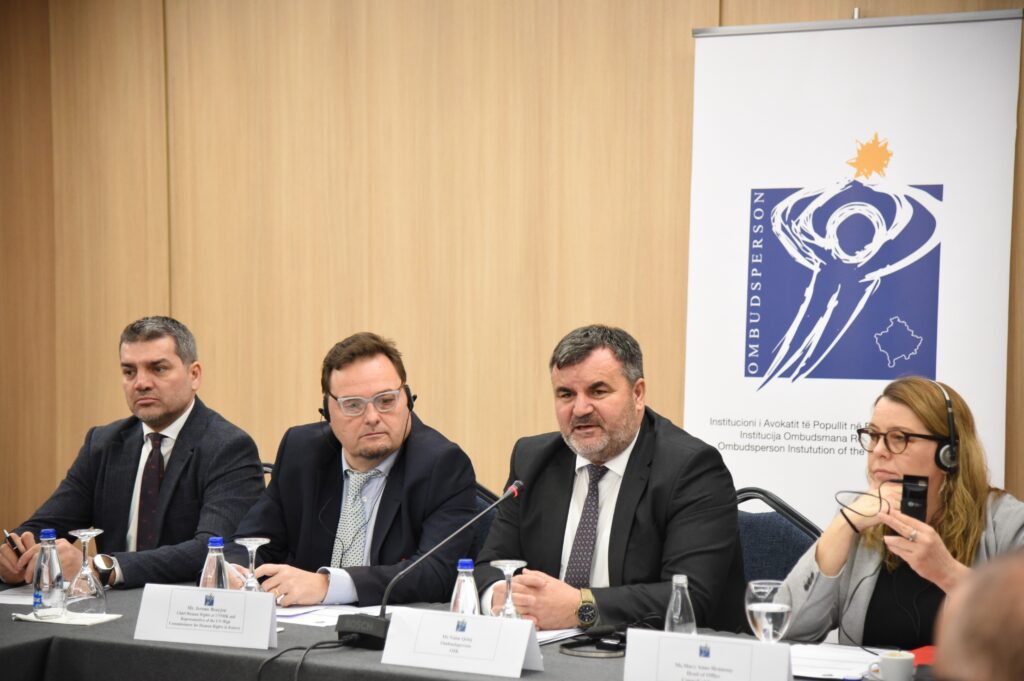
Prishtina, 20 February 2026 – The Ombudsperson Institution of Kosovo organized a roundtable discussion entitled “The Impact of the Ombudsperson in Advancing the Protection of Community Rights in Kosovo”, in cooperation with the Advocacy Center for Democratic Culture (ACDC). The activity brought together representatives of state institutions, civil society organizations, international partners and community representatives to discuss progress, challenges and the way forward in ensuring the effective protection of the rights of non-majority communities in Kosovo.
The event aimed to present the work and impact of the Ombudsperson institution in addressing community rights issues, highlight institutional efforts to uphold Kosovo’s comprehensive constitutional and legal framework on minority rights, and identify concrete steps for addressing remaining challenges. It also highlighted the growing trust that non-majority communities place in the Ombudsperson Institution as a key protector of their rights.
Opening the discussion, the Ombudsperson Naim Qelaj emphasized that Kosovo’s Constitution provides strong guarantees for the protection of community rights, particularly through Chapter III, which sets one of the most advanced legal frameworks for minority protection in the region. He underlined that the Ombudsperson Institution plays a central role in supporting the consistent application of these guarantees, addressing complaints, and assisting institutions in improving policies and practices that strengthen inclusion and equality.
During the past year, the Ombudsperson Institution received 331 complaints from members of non-majority communities, including 207 from members of the Serbian community. These complaints reflect not only the challenges faced by communities but also the increasing confidence of non-majority citizens in the Ombudsperson as an effective and impartial institution for the protection of their rights. The complaints concerned issues such as the implementation of language rights, access to employment opportunities, access to personal documentation, and the realization of economic and social rights. Other cases involved civil status registration, residence registration, and requests for temporary identity cards. Property-related issues also remain a challenge, particularly due to lengthy judicial proceedings.
The Ombudsperson highlighted several important interventions undertaken during 2025 aimed at improving institutional practices and ensuring the protection of citizens’ rights.
Following numerous complaints from parents regarding the suspension of child allowance payments, the Institution issued recommendations to the Ministry of Finance, Labour and Transfers, concluding that additional verification requirements had not been clearly defined or publicly communicated. The Ombudsperson recommended greater transparency in procedures, the issuance of individual administrative decisions, and the retroactive payment of suspended benefits.
Another issue addressed concerned the supply of textbooks for students attending education in Turkish and Bosnian. After the Ombudsperson’s engagement, authorities from the Ministry of Education, Science, Technology and Innovation clarified that steps had been taken to reduce textbook prices and ensure their availability.
In addition, the Ombudsperson published an ex officio report regarding the respect of linguistic rights in banking services. The report identified gaps in the availability of services and documentation in Serbian and recommended that the Central Bank of the Republic of Kosovo establish clearer guidelines and monitoring mechanisms to ensure equal access to services in both official languages.
The Institution has also issued recommendations concerning the respect of the principles of good administration in recruitment procedures and the implementation of the legally established quota for the employment of members of non-majority communities in public institutions.
Complaints received from Roma, Ashkali, and Egyptian communities highlighted additional challenges related to property issues, access to documentation, recognition of the Romani language at the municipal level, labor rights, and access to dignified healthcare services.
Participants acknowledged the progress achieved in establishing a strong legal and institutional framework for the protection of minority rights in Kosovo while emphasizing that continued efforts are needed to ensure its consistent implementation in practice. The roundtable also demonstrated the critical role of the Ombudsperson Institution in fostering trust among non-majority communities, who increasingly rely on it as an impartial mechanism for addressing their concerns.
The Head of the Council of Europe Office in Kosovo, Ms. Mary Ann Hennessey, highlighted that Kosovo has established a solid legal framework for the protection of minority communities. She noted that the increasing trust of minorities in public institutions has been reinforced through the proactive activities and oversight of the Ombudsperson Institution. At the same time, she acknowledged that members of the Roma, Ashkali, and Egyptian communities continue to face challenges, including persistent anti-Gypsyism, and stressed that efforts to fully realize linguistic rights in their mother tongues remain an ongoing priority.
Mr. Jerome Bouyjou, Head of the UNMIK Human Rights Office and Representative of the High Commissioner for Human Rights, emphasized the critical role of civil society in safeguarding human rights and supporting communities. He also noted that the situation of non-majority communities is closely monitored, as in some cases these communities are disproportionately affected, particularly in areas such as freedom of movement and access to employment.
The Minister of Returns and Communities, Mr. Nenad Rašić, welcomed the roundtable and commended the Ombudsperson Institution for its work in identifying societal challenges and supporting government institutions in addressing them. He emphasized the commitment of state authorities to tackling these challenges, including proposing amendments to the Law on Community Rights to ensure greater representation of minorities within public administration.
Representatives from NGOs highlighted several issues for continued attention, including the full implementation of recommendations and accountability among policymakers, with particular reference to language rights. The mechanism for verifying ethnicity in employment procedures was also discussed.
The representative of the Turkish community raised concerns regarding the recognition of diplomas and examinations for students returning from Turkey. Additional issues discussed included illegal construction and environmental pollution in Gračanica, as well as challenges faced by women from the Serbian community in obtaining civil documentation.
The conclusions of this roundtable include:
- Kosovo has established a solid constitutional and legal framework for the protection of community rights, providing a strong foundation for inclusion and equality, though continued efforts are needed to ensure full practical implementation at institutional and local levels.
- Language rights remain a priority, with ongoing work needed to strengthen translation services, institutional capacities, and full implementation of legislation on the use of official languages.
- The increase in complaints from non-majority communities reflects both the growing trust in the Ombudsperson Institution and the need to further enhance public authorities’ delivery of community rights.
- Employment and representation of communities continue to require attention, including ensuring compliance with the 10% quota and improving data collection for Roma, Ashkali, and Egyptian communities.
- Implementation of OIK and NGO recommendations is at a low level, while the lack of parliamentary discussion of the OIK’s annual reports has negatively affected institutional accountability.
- A proactive and timely institutional approach to Ombudsperson recommendations is essential, including careful review and concrete actions for their implementation.
- Cooperation between state institutions, civil society, and international organizations is considered essensial for identifying inclusive solutions, strengthening dialogue, and advancing the protection of community rights.