




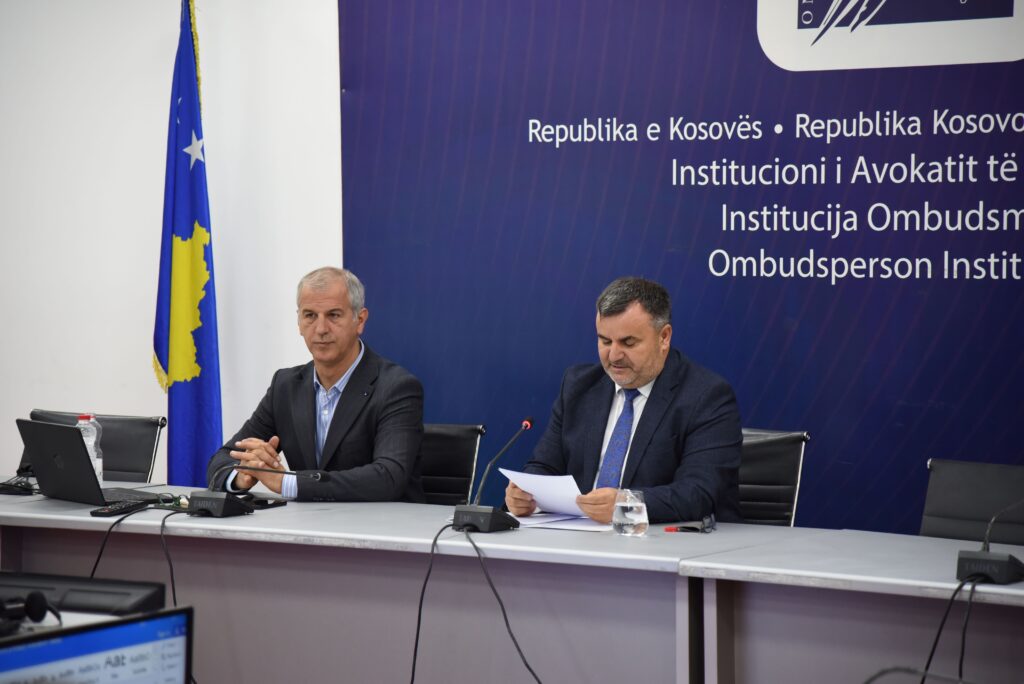
Statement of the Ombudsperson, Mr. Naim Qelaj, on the occasion of the presentation of the report “Preliminary Review of the Kosovo Specialist Chambers”


The Ombudsperson of the Republic of Kosovo has, since 2021, continuously undertaken actions aimed at providing clarification and information regarding the activities of the Kosovo Specialist Chambers (KSC), as well as the conditions under which detainees are held at the KSC. On this occasion, the Ombudsperson engaged an independent organization, the Bar Human Rights Committee of England and Wales (BHRC), to prepare a preliminary review of the KSC, as a result of the Ombudsperson’s serious and ongoing concerns regarding respect for fundamental rights within judicial proceedings before the KSC. The initial concerns were raised as early as the Ombudsperson’s 2021 report and have also been articulated by the accused themselves, as well as through visits conducted by the Ombudsperson of the Republic of Kosovo to detention centres in The Hague.
Furthermore, during a meeting with the President of the Court, Ms Ekaterina Trendafilova, in May 2025, a number of issues were formally raised, which are also reflected in this report, but in relation to which no institutional response or clarification has been received. Following this meeting, visits were conducted to the court and detention facilities, meetings were held with technical representatives of the court, as well as with the defence team and detainees, and two court hearings were observed. In light of the serious concerns identified, further steps were pursued through official communications addressed to the President of the Court, the Committee for the Prevention of Torture, and the International Committee of the Red Cross. The latter two provided responses and sufficient clarifications, whereas the court remained silent.
In the absence of clarifications and responses regarding the concerns raised, an independent, neutral, and professional organization was engaged to carry out a preliminary assessment of the identified issues. The organization was selected based on criteria ensuring professional expertise, impartiality, and integrity. The assessment process was conducted in procedural coordination, without any interference in its content, methodology, or analysis, through to the submission of the final report.
This report constitutes a “Preliminary Review” and is not intended to address the full breadth of human rights issues arising in the proceedings of the Kosovo Specialist Chambers. It is, instead, directed at specific issues identified by the Ombudsperson Institution of Kosovo for review, namely:
– provisional release and pre-trial detention
– judicial independence and impartiality
– admissibility and credibility of evidence
– equality of arms between the defence and the prosecution
– the principle of legality, and
– institutional accountability of the KSC.
The report confirms that the concerns raised are substantive and sufficiently serious to warrant further institutional review. In particular, it finds that the mandate of the KSC has deviated from its original purpose and from the spirit as articulated in the Council of Europe Report (“the mandate of the KSC has undergone change” – paragraph 26).
In relation to detention and the restriction of rights during detention, the report highlights serious concerns regarding the duration of detention, the absence of realistic prospects for provisional release, and limitations on family and professional communications. It notes that “Release in the Netherlands, where the proceedings take place, is unavailable.” (paragraph 53), thereby creating a structural impediment that adversely affects the position of the accused. Furthermore, the systematic monitoring of communications raises concerns under Article 8 of the ECHR, as “systematic monitoring for other purposes constitutes an interference with Article 8” (paragraph 57). In conclusion, the report assesses that this framework raises concern regarding compliance with Article 5 ECHR and Article 9 ICCPR (paragraph 61).
In relation to jurisdiction, accountability, and institutional transparency, the report highlights serious concerns regarding the lack of effective mechanisms for democratic oversight and institutional control. It identifies both a normative and procedural gap in the accountability of the KSC towards funding states and international partners, alongside the absence of internal mechanisms capable of ensuring effective transparency, including in cases of alleged violations of fundamental rights. The report stresses that the combination of extensive powers and the lack of procedural avenues for challenge creates a “gap in the framework” (paragraph 100).
With respect to the standard of a competent, independent, impartial, and lawfully established court, the report identifies considerable concerns regarding the appointment process and the composition of judicial panels. It notes that the President has “considerable discretion to compose Panels” (paragraph 74), which may influence the perception of impartiality, especially at the appellate level. In addition, it raises concerns regarding the inter-institutional consultations provided for under Rule 12 (paragraphs 76-77), as well as the absence of judges from Kosovo, thereby placing in question the competence of the KSC in relation to domestic law and practice (“an exclusively international composition brings into question the competence” – paragraph 106).
The report gives particular attention to matters concerning procedural integrity and the perception of impartiality, arising from the participation of the President, the Specialist Prosecutor, and the Registrar in a diplomatic briefing not disclosed to the defence in any pending case (paragraph 83). It finds that statements attributed to the Prosecutor, including predictions of life sentences and opposition to provisional release, remain uncontested (“The statements […] remain uncontested” – paragraph 101). These circumstances, according to the report, give rise to serious concerns not only in relation to the presumption of innocence, but also regarding the integrity of the provisional release process (paragraph 102), as well as the lack of procedural transparency (paragraph 103).
In relation to the admissibility of evidence, and in particular evidence originating from Serbia, the report highlights considerable legal uncertainty. The practice of provisional admission of evidence, coupled with the deferral of final assessment until judgment, is described as a potential source of procedural unfairness and uncertainty for the parties (“a source of significant uncertainty and potential unfairness” – paragraph 115). As regards evidence originating from Serbia, the report finds a serious lack of transparency, as defence requests for access and disclosure concerning the origin of materials remain without a public decision (“The absence of any publicly available ruling is itself a transparency concern.” – paragraph 138).
As regards the principle of equality of arms, the report identifies preliminary concerns that affect the effectiveness of the defence, including restrictions on privileged visits, inadequate time and facilities to prepare a defence, delayed and partial disclosure of evidence, concurrent proceedings, and unilateral changes to the legal aid system. It concludes that these factors constitute serious indicators requiring further scrutiny, while at the same time stating that no definitive conclusion on concrete violations can be drawn at this stage (“cannot support a finding of a violation […] in any particular case” – paragraph 148).
In relation to the principle of legality, the report expresses concerns concerning the use of norms and standards stemming from the Rome Statute, adopted subsequent to the temporal jurisdiction of the KSC. It underlines that reliance on post-relevant legal sources “runs the risk of adopting an interpretation of customary international law that is temporally inconsistent with the actus reus under consideration” (paragraph 176). Accordingly, it concludes that there is a real risk that the normative framework of criminal offences may not be fully consistent with the principle of legality (“creates risk […] inconsistent” – paragraph 209).
In conclusion, the report emphasizes that this document constitutes a preliminary assessment and does not amount to a final finding, yet it identifies a number of serious and well-documented concerns that cannot be disregarded. It further underlines that the appropriate benchmark for assessment should be the Constitution of Kosovo and the ECHR, rather than potentially problematic practices of other international tribunals. For this reason, the BHRC recommends the establishment of a sustainable, independent, and adequately funded mechanism for the continuous monitoring of judicial proceedings before the KSC, stressing that institutional credibility and legitimacy require effective external oversight.
The Bar Human Rights Committee of England and Wales (BHRC) is an independent legal organisation based in the United Kingdom, affiliated with the legal profession in England and Wales.
In light of the authority, professional integrity, and international credibility of the Bar Human Rights Committee of England and Wales, as well as the independent and documented character of this preliminary review, the report carries considerable legal and institutional weight, as it identifies serious concerns directly engaging core human rights standards, including the right to a fair trial under Article 6 of the ECHR, the right to liberty and security, protection of liberty, respect for private and family life, and the effectiveness of legal defence.
While the report does not reach conclusive findings of specific violations, the level and nature of the identified concerns create a real risk of systemic impairment of these rights and require urgent institutional attention. The central message emerging from the report is the need for immediate strengthening of transparency, accountability, and independent oversight mechanisms, in order to prevent procedural or structural deficiencies from undermining the legitimacy of the judicial process.
In this context, the Ombudsperson should maintain its engagement in the further review of issues which, owing to their complexity, duration, and procedural scope, could not be fully addressed at this preliminary stage, including continuous monitoring and supplementary thematic analysis.
Simultaneously, national authorities have an institutional and constitutional obligation, for the purpose of safeguarding fundamental rights and the integrity of the justice system, to address these findings through active institutional engagement, the strengthening of independent monitoring mechanisms, and ensuring full compliance with the Constitution of Kosovo and international human rights instruments.