




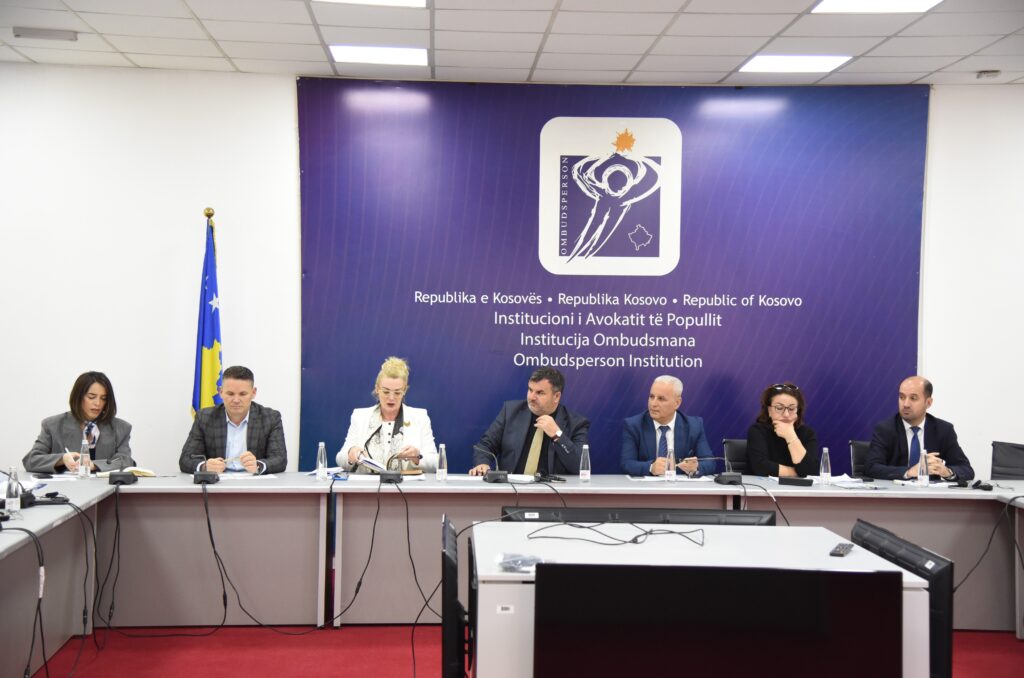
The Ombudsperson organized a roundtable discussion on the challenges in the implementation of psychiatric measures in freedom and the supervision of conditional release


Pristina, 9 March 2026 – The Ombudsperson organized a roundtable discussion on the topic “Challenges in the implementation of mandatory psychiatric measures in freedom and the supervision of conditional release by the responsible institutions”.
This roundtable was attended by representatives from relevant institutions, including the Kosovo Probation Service, the Parole Panel, the Kosovo Correctional Service, Mental Health Centers, Social Work Centers, the judiciary, representatives from international organizations and civil society.
The Ombudsperson, Mr. Naim Qelaj, emphasized the importance of treating persons with mental disorders with dignity and the need to strengthen inter-institutional cooperation for the effective implementation of psychiatric measures and conditional releases.
The Deputy Ombudsperson, Mr. Basri Kastrati also welcomed the participants and expressed the hope that the discussions of this roundtable will contribute to the identification of challenges and the issuance of concrete recommendations for the improvement of institutional practice.
During the discussions, representatives of the institutions highlighted a number of challenges in the practical implementation of psychiatric measures in freedom and in the supervision of conditional release.
Representatives of the Kosovo Probation Service underlined that one of the main challenges remains the existence of parallel decisions between the courts and the Conditional Release Panel regarding early releases, which creates uncertainty and ambiguity in practice. Also, difficulties in the procedures for the revocation of conditional release and cases where convicted persons do not have a clear address or residence, making effective monitoring impossible, were highlighted.
Representatives of the Mental Health Centers highlighted other challenges, such as the stigmatization of persons with mental disorders, the lack of human resources and the large number of cases treated by a limited staff. It was also emphasized that court decisions on compulsory treatment in freedom are often delayed or not communicated in a timely manner to the relevant institutions, which makes their implementation in practice difficult.
The discussion also mentioned the need to improve inter-institutional coordination, to clarify the competencies between the responsible institutions and to develop joint cooperation protocols, in order to ensure the more effective implementation of psychiatric measures and the supervision of conditional releases.
Representatives of international organizations and civil society emphasized the importance of further developing alternative measures and the need for institutional support in the treatment of persons with mental health problems, including persons addicted to narcotic substances.
At the conclusion of the roundtable, the Ombudsperson emphasized that inter-institutional cooperation and respect for human rights standards are essential for a more functional and effective system in the treatment and supervision of these cases. He added that the Ombudsperson will continue to monitor this area and contribute to addressing the challenges identified through recommendations and institutional dialogue.